Showing posts with label science. Show all posts

Monday, April 30, 2007

new blog: fish wars


Wendee Holtcamp, a Christian bohemian evolutionist and author has a new blog worth checking out: The Fish Wars. It is a commentary on Christian faith and and science.

I've always been fascinated by the debate between science and religion, and have done some interesting research on it, as well as looking at the debate from a philosophical perspective. Let me state a few facts about this debate for the record:

1. Christianity has done far more to help foster science and research than it has to thwart it. While there are those who love to hold up examples like the persecution of Galileo, it should be noted that when major paradigms of thought are overthrown, there is often a backlash. This is not just a science vs. religion issue, but even within the scientific community, perhaps especially within the scientific community, there can be tremendous resistance to new, revolutionary ideas and theories. (Those who have done a bit of research into the history of science know what I'm talking about.) No where on earth has science and technology flourished more bountifully than in Protestant Christian nations, especially those of the former British empire. The reason for this is that freedom of speech and thought, long supported by Protestant Christians, have allowed paradigm shifting ideas to develop without too much fear of retribution. (Though that fear can never be completely eliminated, nor should it...)

2. The modern debate between science and religion is really just a one-horse buggy: that buggy being evolution. Christians, especially conservative Christians, are very suspicious of evolution, not because it thwarts the creation account of Genesis, but because it's biggest proponents have been militant atheists, starting with Thomas Huxley, a.k.a. "Darwin's Bulldog." (Note: early atheists like Huxley and famous lawyer Clarence Darrow used the term "agnostic" rather than "atheists" mostly for public relations purposes. Upon close examination of both men's thoughts and world views, they were both militant atheists in all but name.)

3. With the exception of evolution, Christians, even very conservative ones, have no problems with other scientific disciplines. For example, there is no backlash against chemistry or physics, or even most aspects of biology. It is evolution alone, and those who promote it that raises the suspicions of many Christians, let alone people of other faiths. Even young earth creationists often resort to scientific explanations for their beliefs!

4. This may surprise many of you, but evolution is far from a proven fact. There are still a lot of biological problems that evolution does a poor job explaining. You will not find much about this on the web, but such issues are discussed and studied in academic circles. One of the problems that has has a bit of public exposure is the problem of stasis. The fossil record, surprisingly, has little if any truly transitional forms. Often the earliest instance of a creature will change very little from it's last instance, even when hundreds of millions of years are involved. Also, almost all of the animals that exist on earth today have very close, if not identical ancestors that go back to the days of the dinosaurs. If evolution is true, why is there so much evidence of stasis in the fossil record, and so little evidence of transitional forms? An attempt to solve this problem is the theory of "punctuated equalibrium" put forth buy Stephen J. Gould.

5. Evolution is not a repudiation of the Genesis creation account, nor is the Genesis account a repudiation of evolution. Genesis functions more like a parable than a journalistic account of what exactly happened at the moment of creation. Nor does evolution does not do way with the need for a creator, as there is still a need to explain origins of life and the universe. Evolution can give us a "how" but not a "why" answer to life itself.

6. The denial of evolution as an explanatory means for the origin of the species is not just a religious issue, there atheists who have problems with it as well, even atheistic scientists. Just like there are Christians who are in complete agreement with evolution.

7. While evolution is not a proven fact of history, it's negative impact on humanity certainly is, especially when you realize its philosophical and theological implications. The most evil regimes of the past 100 years, including Nazi Germany and various communist regimes were all completely in favor of evolution and it's implications, while usually being entirely opposed to religion in any form. However, even here in America, the science of eugenics (now mostly ignored) was a direct response to the ideas of evolution. Looking at history since the publication of Origin of the Species, one can be very hard pressed to find any beneficial effects it's ideas have had on humanity.

<>< TM

Friday, April 13, 2007

Einstein on God, atheism, science and religion


While speaking on the topic of atheism...

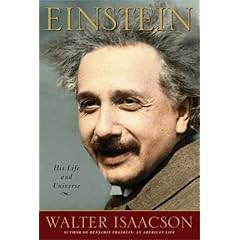
Here are some excellent quotes from Albert Einstein about God, religion, science and atheism from the soon to be released book Einstein: His Life and Universe by Walter Isaacson. © 2007 by Walter Isaacson. (To be published by Simon & Schuster, Inc.)

Shortly after his 50th birthday, Einstein also gave a remarkable interview in which he was more revealing than he had ever been about his religious sensibility. It was with George Sylvester Viereck, who had been born in Germany, moved to America as a child and then spent his life writing gaudily erotic poetry, interviewing great men and expressing his complex love for his fatherland. Einstein assumed Viereck was Jewish. In fact, Viereck proudly traced his lineage to the family of the Kaiser, and he would later become a Nazi sympathizer who was jailed in America during World War II for being a German propagandist.

Viereck began by asking Einstein whether he considered himself a German or a Jew. "It's possible to be both," replied Einstein. "Nationalism is an infantile disease, the measles of mankind."

Should Jews try to assimilate? "We Jews have been too eager to sacrifice our idiosyncrasies in order to conform."

To what extent are you influenced by Christianity? "As a child I received instruction both in the Bible and in the Talmud. I am a Jew, but I am enthralled by the luminous figure of the Nazarene."

You accept the historical existence of Jesus? "Unquestionably! No one can read the Gospels without feeling the actual presence of Jesus. His personality pulsates in every word. No myth is filled with such life."

Do you believe in God? "I'm not an atheist. I don't think I can call myself a pantheist. The problem involved is too vast for our limited minds. We are in the position of a little child entering a huge library filled with books in many languages. The child knows someone must have written those books. It does not know how. It does not understand the languages in which they are written. The child dimly suspects a mysterious order in the arrangement of the books but doesn't know what it is. That, it seems to me, is the attitude of even the most intelligent human being toward God. We see the universe marvelously arranged and obeying certain laws but only dimly understand these laws."

Is this a Jewish concept of God? "I am a determinist. I do not believe in free will. Jews believe in free will. They believe that man shapes his own life. I reject that doctrine. In that respect I am not a Jew."

Is this Spinoza's God? "I am fascinated by Spinoza's pantheism, but I admire even more his contribution to modern thought because he is the first philosopher to deal with the soul and body as one, and not two separate things."

Do you believe in immortality? "No. And one life is enough for me."

Einstein tried to express these feelings clearly, both for himself and all of those who wanted a simple answer from him about his faith. So in the summer of 1930, amid his sailing and ruminations in Caputh, he composed a credo, "What I Believe," that he recorded for a human-rights group and later published. It concluded with an explanation of what he meant when he called himself religious: "The most beautiful emotion we can experience is the mysterious. It is the fundamental emotion that stands at the cradle of all true art and science. He to whom this emotion is a stranger, who can no longer wonder and stand rapt in awe, is as good as dead, a snuffed-out candle. To sense that behind anything that can be experienced there is something that our minds cannot grasp, whose beauty and sublimity reaches us only indirectly: this is religiousness. In this sense, and in this sense only, I am a devoutly religious man."

.....

But throughout his life, Einstein was consistent in rejecting the charge that he was an atheist. "There are people who say there is no God," he told a friend. "But what makes me really angry is that they quote me for support of such views." And unlike Sigmund Freud or Bertrand Russell or George Bernard Shaw, Einstein never felt the urge to denigrate those who believed in God; instead, he tended to denigrate atheists. "What separates me from most so-called atheists is a feeling of utter humility toward the unattainable secrets of the harmony of the cosmos," he explained.

In fact, Einstein tended to be more critical of debunkers, who seemed to lack humility or a sense of awe, than of the faithful. "The fanatical atheists," he wrote in a letter, "are like slaves who are still feeling the weight of their chains which they have thrown off after hard struggle. They are creatures who--in their grudge against traditional religion as the 'opium of the masses'-- cannot hear the music of the spheres."

Einstein later explained his view of the relationship between science and religion at a conference at the Union Theological Seminary in New York. The realm of science, he said, was to ascertain what was the case, but not evaluate human thoughts and actions about what should be the case. Religion had the reverse mandate. Yet the endeavors worked together at times. "Science can be created only by those who are thoroughly imbued with the aspiration toward truth and understanding," he said. "This source of feeling, however, springs from the sphere of religion." The talk got front-page news coverage, and his pithy conclusion became famous. "The situation may be expressed by an image: science without religion is lame, religion without science is blind."

SOURCE: Time: 5 APRIL 2007: Einstein and Faith

HAT TIP: Get Religion

<>< TM